An early named dinosaur
Iguanodon was named in 1825, making it one of the first non-avian dinosaurs recognized by science.
Cautiously giving this a thumbs-up.
You are open to the idea. Once the details are checked, the route is established, and somebody has confirmed the return policy. Enthusiasm, with sensible terms and conditions.
SIGNATURE MOVEReading the instructions everyone else threw away.
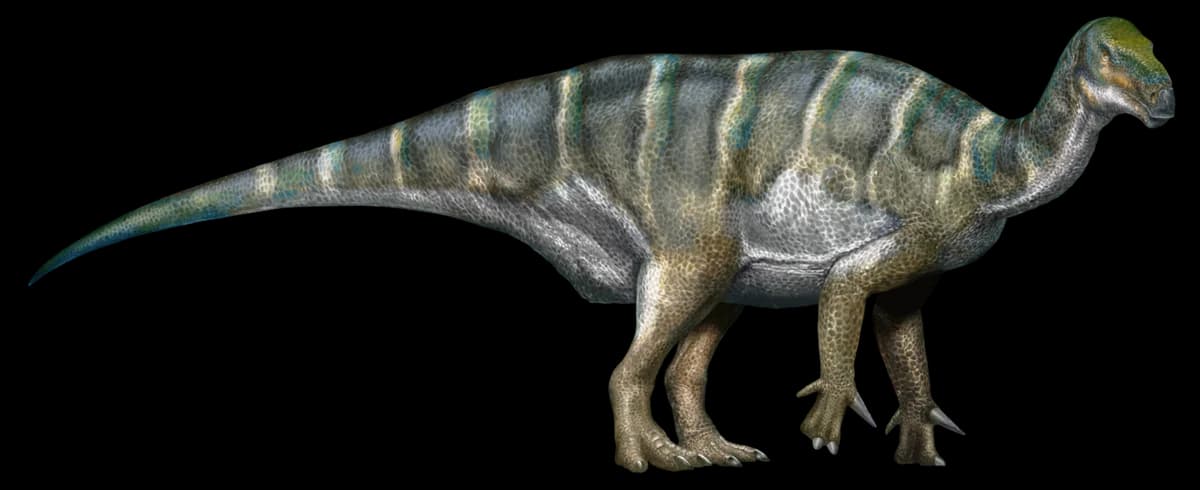 IGUANODON BERNISSARTENSIS · HERBIVORE
The jokes are ours.
The animal was very real.
Iguanodon was named in 1825, making it one of the first non-avian dinosaurs recognized by science.
A thumb spike was initially reconstructed as a horn on the nose before more complete skeletons clarified its position.
A Belgian coal mine yielded numerous skeletons in 1878, radically improving knowledge of the animal.
The hand combined weight-bearing digits, a thumb spike, and a more flexible outer finger.
A beak cropped vegetation, while rows of teeth processed food farther back in the jaws.
Early upright, tail-dragging mounts have been replaced by more horizontal reconstructions with the tail held off the ground.
Many fossils once assigned to Iguanodon have been reclassified. Older books may give it a much broader range than current taxonomy supports.
Read more: Iguanodon on Wikipedia · Research and references. Facts are summarized in our own words. Size and date ranges are approximate; estimates vary by specimen and study. Gallery images may include other species within the genus.
Fossils, museum displays, and published reconstructions. Artwork shows an interpretation; it is not a photograph of a living dinosaur.
Eight questions and an optional face scan will settle this. Very unofficially.